%%{init: {'theme': 'base', 'themeVariables': {'fontSize': '20px', 'edgeLabelBackground': 'transparent'}, 'flowchart': {'rankSpacing': 20, 'nodeSpacing': 20, 'padding': 0}}}%%
graph LR
SRC["*.spy source"]
MOD["Untyped AST<br/>+ symtable<br/>+ modules"]
RED["Typed AST<br/>(Redshifted)"]
C["C source (.c)"]
OUT1(["output"])
OUT2(["output"])
NAT["native exe"]
WASI["WASI exe"]
EM["Emscripten"]
OUT3(["output"])
SRC -->|parse<br/>+ scope analysis<br/>+ import| MOD
MOD -->|redshift<br/>+ type checking| RED
MOD -->|interp.| OUT1
RED -->|interp.| OUT2
RED -->|cwrite| C
C -->|cc| NAT
C -->|cc| WASI
C -->|cc| EM
NAT --> OUT3
WASI --> OUT3
EM --> OUT3
classDef output fill:#1D9E75,stroke:#0F6E56,color:#E1F5EE
classDef exe fill:#BA7517,stroke:#854F0B,color:#FAEEDA
classDef src fill:#534AB7,stroke:#3C3489,color:#EEEDFE
classDef ast fill:#185FA5,stroke:#0C447C,color:#E6F1FB
classDef c fill:#993556,stroke:#72243E,color:#FBEAF0
class OUT1,OUT2,OUT3 output
class NAT,WASI,EM exe
class SRC src
class MOD,RED ast
class C c
SPy 🥸 & the Python Native Interface
Will Python keep its edge in the next decade?
Pierre Augier
JDEV 2026



Outline
1. The Big Picture
- Python’s strengths and structural problems
- The C API bottleneck
- Two remedies: Py-NI and SPy
2. SPy 🥸: A New Companion Language
Design principles, the Blue/Red model, compilation pipeline
3. SPy 🥸 Quick Syntax Tour
4. SPy in Action: Three Demos
5. SPy’s Impact on the Python Ecosystem
6. The Road Ahead
Who am I? Pierre Augier
CNRS researcher in fluid mechanics — LEGI, Grenoble
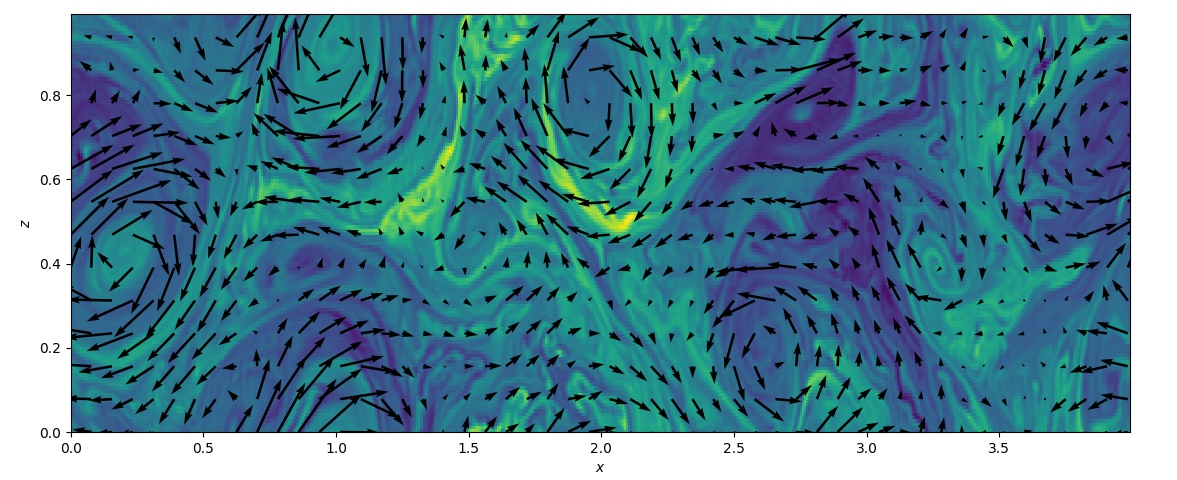
- Creator and maintainer of FluidDyn: a collection of Python packages for fluid dynamics
- FluidSim, FluidFFT, Fluidimage, Transonic, PyFFTW, …
- Founding member of the Python CNRS working group and py-edu-fr
- Co-author of the draft Python Native Interface (Py-NI) PEP
- Active contributor to SPy
The Big Picture
Python in 2026
Why Python dominates
Coding for people
Science, data science, machine/deep learning, AI, ..
Unmatched ecosystem (NumPy, SciPy, PyTorch, TensorFlow,…)
Wonderful developer experience
Massive community
But Python has real structural problems.
Where Python falls short
- ⚡ Low-level performance
- 🚀 Fast startup time
- 📦 Small self-contained binaries
- 🌐 Browser deployment
- 🔬 Microcontrollers / edge computing
- 🏷️ Typing as good as static languages
Without structural improvements, Python risks losing ground — new projects in critical domains may start elsewhere.
The Two-Language Wall
Python provides the developer experience; C/C++/Fortran/Rust provides the performance.
- NumPy, SciPy, PyTorch, Polars: fast core + Python interface
- Inconvenient — but manageable. Cython, cffi, PyO3 help.
- Not the deepest problem.
The Python C API: the foundation and the bottleneck
The C API exposes CPython internals — refcounts, object layout.
Consequences:
- Extensions are coupled to CPython — PyPy and GraalPy struggle to run the ecosystem
- CPython cannot restructure its own internals without breaking thousands of extensions
- CPython’s JIT is constrained by what the C API promises
Note
CPython is still significantly slower than PyPy and GraalPy for pure Python code — yet the ecosystem’s dependency on the C API prevents most projects from switching.
This is not a developer experience problem. It is a structural problem.
Current Solutions and Their Limits
| Tool | Approach | Limits |
|---|---|---|
| Cython | Hybrid C/Python syntax | No interpreter, no standalone binary, C feel |
| Pythran | AOT compile annotated Python | Limited scope, no interactive dev |
| Numba / JAX | JIT compilation | Incompatible with AOT tools |
| PyPy / GraalPy | Full meta-JIT | Can’t run C extensions well |
| CPython JIT | Copy-and-patch | Blocked by C API constraints |
No existing tool lets you write something like NumPy without direct use of the Python C API.
Julia and Mojo are excellent individual choices — but they don’t fix Python’s ecosystem. NumPy, SciPy, the notebooks, a lot of researchers: they stay in Python/C. Real fixes must come from within.
Two Structural Remedies
1. Python Native Interface (Py-NI)
A modern C API and universal ABI for CPython extensions.
- Extensions built against Py-NI run across CPython versions and alternative runtimes without recompilation
- Unlocks CPython to restructure internals (JIT, GC, …)
- Draft PEP: github.com/py-ni/peps
2. A new companion compilable language
- Py-NI alone does not provide a good tool to implement NumPy-like libraries without writing C
- We need a Pythonic language that compiles to native code
- This is where SPy 🥸 comes in
I presented Py-NI and related Python C API issues at PyConFr 2025 — for this talk, let’s focus on SPy.
SPy 🥸: A New Companion Language for Python
What is SPy?
SPy 🥸 is a 🚧 new 🚧 language, created by Antonio Cuni (PyPy, PyScript, Anaconda).
SPy is a variant of Python specifically designed to be statically compilable while retaining a lot of the “useful” dynamic parts of Python.
Key resources:
SPy has:
- An interpreter — usual Python development experience
- A debugger —
spdb, works at the SPy level - A compiler — for native speed
SPy is designed to become a companion language for Python and its community.
SPy is not
- an efficient Python interpreter — SPy source in
.spy - another acceleration tool for Python code
SPy Name — Origin
Static Python
“S” is the letter after R
Successor of RPython (used to implement PyPy)
RPython is a restricted subset of Python (2.7) that is amenable to static analysis.
SPy is a direct consequence (and the continuation) of the PyPy project.
SPy Design Goals (Antonio Cuni)
- Easy to use and to implement
- Has an interpreter
- Has a compiler
- Static typing
- Performance matters
- Predictable performance
- Rich metaprogramming capabilities
- Zero-cost abstractions
- Opt-in dynamism
- One language, different levels
Consequences
- Simple — very close to Python
- But also notable differences with Python
⇒ SPy is a Python variant.
SPy Design — Simple and similar to Python, but …
Choices
Language:
On many aspects, just like Python:
Functions,
for/while,range(),slice(),print(),open(),tuple,list,dict, decorator, …Not yet supported but soon:
f-strings,try/except,with
Also quite fundamental differences and novelties
Compilable & proper type errors ⇒ “static”
Type annotations for “red” functions
Internals:
- Memory management: Garbage Collector (GC)
- SPy compiler emits C code, not LLVM
Under the Hood — Simple, Clean and Robust
Currently implemented in:
- Python (CLI, interpreter, compiler) — later in SPy
- A small C runtime library (
libspy) - Stdlib types (
list,dict,tuple) written in SPy itself
WASM-centric architecture:
WebAssembly (WASM) is a binary instruction format designed to run at near-native speed in a sandboxed environment.
- Interpreter loads
libspy.wasmviawasmtime - Same
libspyis statically linked in compiled executables - Works on top of Pyodide (in-browser) without
wasmtime
SPy Design — Three Levels
End users / High level
Typically what most Python users use.
Advanced power users
Advanced metaprogramming
Low level / potentially unsafe
In CPython, low level means C (or specified and limited tools). In SPy, low level is still SPy.
SPy Design — Clear Separation Between 2 Execution Times
Compile time
Dynamic
Novel compilation phases: “Imports” and “Redshift”
Run time
Static & fully typed
⇒ differences with Python
Module level code executed at import time
main()functionBlue/Red expressions &
@bluefunctions
Core Innovation: the Blue/Red Distinction and Redshifting
🔵 Blue expressions & functions
Values known at compile time
Functions can be annotated as
@blue:- run (interpreted) at compile time
- do not need to be annotated
🔴 Red: not 🔵
redshift phase (compile time)
- Full Python dynamism available
- Partial evaluation of blue expressions: 🔵 + 🔵 → 🔵
- Blue functions run: 🔵(🔵, 🔵) → 🔵
- Base of the type systeme, concretize generic types
- Static dispatch & type checking
Redshifted typed AST: 🔴 + 🔵
- Fully static / no Python dynamism
- Statically typed and dispatched
- What is executed at run time
- What goes into the compiled binary
Note: Blue/red is similar to Zig’s comptime — compile-time execution of the same language, enabling zero-cost generic programming.
Example Blue/Red and Redshifting
@blue.generic: a @blue functions that has to be called with brackets
adder.spy
Example Blue/Red and Redshifting
Result of spy colorize adder2.spy
def add[T](x: T, y: T) -> T:
    return x + y

def main() -> None:
    add_i32 = add[i32]       # evaluated at compile time
    result = add_i32(3, 4)   # fast red execution at runtime
    result_f = add[f64](3.0, 4.0)
Result of spy redshift adder2.spy
def main() -> None:
    result: i32 = `add[i32]`(3, 4)
    result_f: `f64` = `add[f64]`(3.0, 4.0)

def `add[i32]`(x: i32, y: i32) -> i32:
    return `operator::i32_add`(x, y)

def `add[f64]`(x: `f64`, y: `f64`) -> `f64`:
    return `operator::f64_add`(x, y)
The Compilation Pipeline
AST: Abstract Syntax Tree — a structured representation of the source code used by compilers and interpreters.
Commands to inspect the pipeline:
Utilities
SPy in the Landscape of Compiled Languages
SPy 🥸 is a proper language, that should be compared with other languages!
| C++ | Rust | Mojo | Go | SPy | |
|---|---|---|---|---|---|
| Memory model | Manual | Ownership | Ownership | GC | GC + Manual |
| Interpreter | ❌ | ❌ | ✅ | ❌ | ✅ |
| Pythonic syntax | ❌ | ❌ | ✅ | ❌ | ✅ |
| Python interop | via bindings | via bindings | ✅ | ❌ | ✅ (goal) |
| Compile-time metaprogramming | templates | macros | Parameters/comptime/alias |
limited | blue/red |
| WASM first-class | ❌ | partial | ❌ | partial | ✅ |
| Status | mature | mature | beta | mature | alpha |
SPy versus Mojo
Mojo: Python-like syntax with C++/Rust-level control — ownership, lifetimes, MLIR backend.
A replacement strategy: you leave Python’s world for a more powerful but far more complex language.
SPy: stay close to Python, keep the implementation approachable, use a GC.
Companion language that Python and its community can actually adopt.
SPy 🥸 Quick Syntax Tour
(focussed on differences with Python)
Programs and main function
hello world
argv
return value
Module level code frozen after import
Module level code very limited (definitions and assignments).
Global variables are by default constant but…
New var keyword
Output
my_var: 2
my_var: 10
Local blue constant with const
New const keyword
# module level variables are constant and blue
MY_CONST = 2

def main() -> None:
    # one can also declare local blue constant
    const MY_LOCAL_CONSTANT = 42
    print(MY_CONST + MY_LOCAL_CONSTANT)

    # variables assigned exactly once are implicitly `const`
    my_var0 = 2
    print(MY_CONST + my_var0)

    my_var1 = 0
    my_var1 = 1
    print(MY_CONST + my_var1)
Result of spy redshift const.spy
def main() -> None:
    `_print::println[str]`('44')
    `_print::println[str]`('4')
    my_var1: i32 = 0
    my_var1 = 1
    `_print::println[i32]`(`operator::i32_add`(2, my_var1))
Structs (like C and Rust structs)
__new__,__make__- special methods (e.g. for operator dispatch with
__add__and co.) @classmethod,@staticmethod,@properties, class variables
Immutable/mutable
- immutable when defined on the stack (
Point(1, 2)) - mutable with heap allocation (
gc_alloc[Point](1))
Notes
- currently, all arguments passed by values (copied)
- currently, no Python like classes (“heap allocated”), no heritage & no protocols/traits
Generic functions and structs
Generic functions ( @blue.generic) defined with parameters in []
Same for generic types (structs)
Example:
from unsafe import gc_alloc, gc_ptr

@struct
class ArrayData[DTYPE]:
    length: i32
    capacity: i32
    items: gc_ptr[DTYPE]

@struct
class Array1d[DTYPE]:
    __ll__: gc_ptr[ArrayData[DTYPE]]

    def __new__(length: i32) -> Self:
        ll = gc_alloc[ArrayData[DTYPE]](1)
        ll.length = length
        ll.capacity = length
        ll.items = gc_alloc[DTYPE](length)
        return Self.__make__(ll)
Advanced SPy
Very interesting but no time for that here!
See Antonio’s presentation at PyConIt 2026 and the Online playground!
@blue.metafuncand (variadic) meta-args@force_inline__convert_from__,__convert_to__unrollfor blue iterators
Note
- Advanced metaprogramming without macros.
- Used in the stdlib to implement
list,tuple,dict,array,print, …
SPy 🥸 in Action: Three Demos
- Server on AWS Lambda
- SPy in the Browser
- Array computing with loop fusions
Demo 1 — SPy serving web requests on AWS Lambda
Antonio Cuni’s demo: github.com/spylang/demos/tree/main/aws-lambda
- Python-like ergonomics (like FastAPI)
- Startup time and performance matching Go or Rust (no Python runtime to initialise)
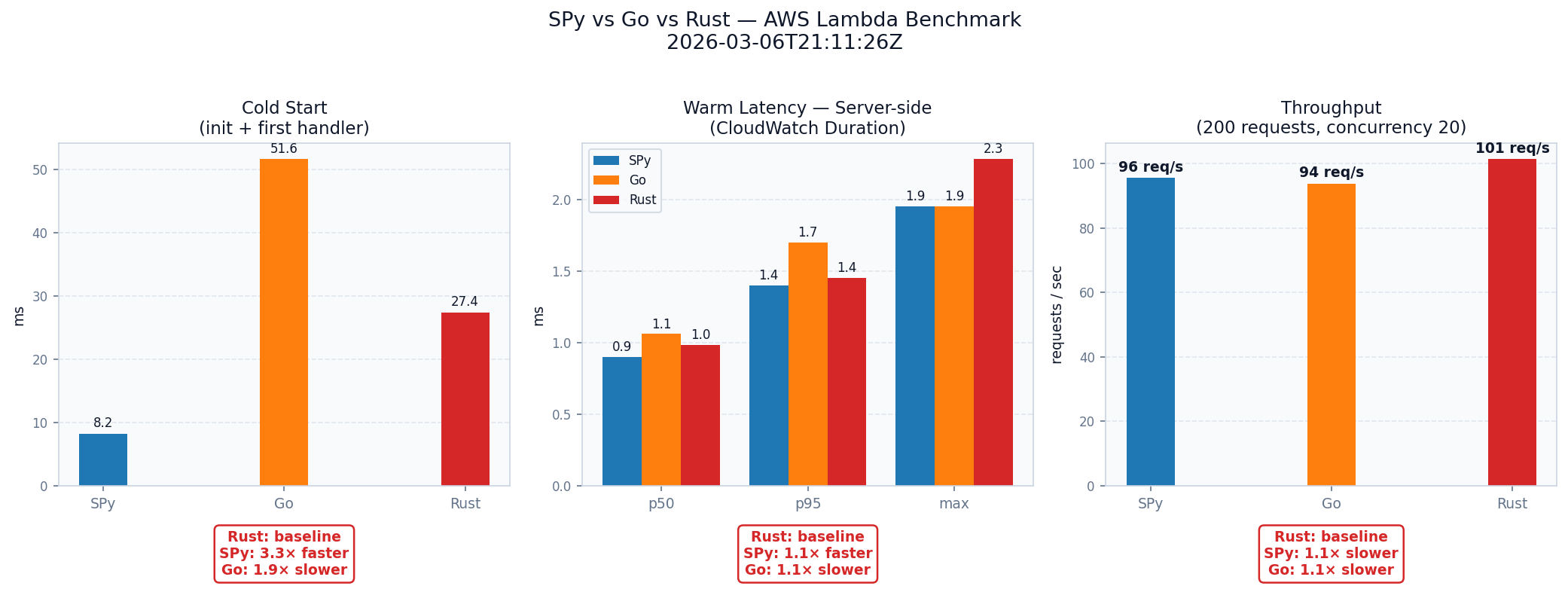
This is the promise of SPy: write it like Python, deploy it like Go.
Demo 2 — SPy in the Browser (JSFFI, PR #484)
No PyScript, no Pyodide, no hand-written JavaScript.
Two browser demos:
- particles — 60fps bouncing particle simulation canvas 2D API:
arc,fillRect,createRadialGradient - image_data — colour animation driven by RGB sliders rendered via
putImageData
⚡ Performance & tiny binaries
Compiled binary sizes:
| File | Size |
|---|---|
.wasm |
~27 KB |
Emscripten glue .mjs |
~64 KB |
| Total | ~91 KB |
Compare to:
- PyScript/Pyodide: ~10 MB
- A typical webpage image: often larger
Demo 3 — Loop Fusion
Efficient array computing à la NumPy/Pythran, written in SPy.
Implement minimal array libraries with loop fusion
Multiple operations on an array merged into a single pass
Avoids intermediate allocations
Enables the C compiler to use SIMD instructions
Same technique as Pythran with C++ expression templates
Advanced SPy code: requires blue.metafunc, __convert_from__, @force_inline, …
SPy’s Impact on the Python Ecosystem
What a Mature SPy Could Enable
Four major use cases:
- NumSPy — Python-native scientific packages
- A better Cython / Pythran — wrapping and numerical kernels
- Fast native entry points — small binaries, fast startup
- Large applications — fast prototyping, speed & production robustness
Two long-term low hanging fruits with a mature SPy:
Not in current SPy roadmap!
- An alternative to MicroPython — microcontrollers and edge devices
- A better RPython — implementing runtimes and interpreters
1. NumSPy: The Core Vision
Write packages like NumPy in SPy — not C with a Python wrapper.
NumSPy (planned) = reimplementation of the Python Array API standard in SPy.
- Whole-program optimisation. C compiler sees both app logic and array library.
- Not coupled to CPython internals. With Py-NI’s universal ABI: runs unchanged on any CPython version, PyPy, GraalPy, any conforming runtime.
Less ecosystem coupling to C API internals
- ⇒ more freedom for CPython developers
- ⇒ faster CPython
- ⇒ people can use PyPy, GraalPy, …
2. A Better Cython
| Cython | SPy | |
|---|---|---|
| Syntax | Hybrid C/Python | Python-like |
| Output | Python extensions only | Extensions + native + WASM |
| Standalone binary | ❌ | ✅ |
| Developer experience | Develop → compile → test | Develop → interpret → compile |
| Interpreter | ❌ | ✅ |
| Debugger | Via gdb (C level) |
spdb (SPy level) |
SPy + NumSPy: also a better Pythran!
3. Fast Native Entry Points
The startup time problem: Every Python script invocation initialises the Python runtime — noticeable for short-lived commands.
- Mercurial (
hg): great VCS written in Python (with C and Rust extensions) uv: Python package manager written in Rust, embraced for its speed- PDM: great Python project manager written in Python and following packaging PEPs
A tool like PDM reimagined in SPy: self-contained, fast, Pythonic.
SPy path: write CLI tools in SPy → compile to native binary → startup like Go or Rust
- No Python runtime needed on the target machine
- Deployable: Linux, AWS Lambda, browser (WASM), microcontrollers
4. Fast prototyping, Speed & Production Robustness
Python is great for prototyping. SPy bridges the gap to production:
- Prototype in Python (or SPy) — full dynamism, fast iteration
- Partly or fully convert in SPy — add type annotations
- Compile with SPy — types enforced at compile time, native speed
- No rewrite in C/Rust/C++
Attractive for large scientific or engineering applications where the same codebase needs to be both approachable and performant.
5. An alternative to MicroPython
MicroPython brings Python to microcontrollers — but with significant trade-offs:
Interpreted only: limited performance, energy inefficiency, large binary.
⇒ For serious embedded applications, C or Rust remain unavoidable.
SPy’s advantages for embedded / edge targets:
- Compiles to tiny native binaries via C
- Targets WASI (portable) and bare-metal
- Native performance (time and energy)
- One language usable both for development (interpreter) and deployment (compiler)
- Code shared with the rest of the SPy ecosystem
MicroSPy, a SPy interpreter as small as MicroPython, is not an immediate goal.
6. A Better RPython
RPython (used to write PyPy) demonstrated: a statically compilable Python variant is excellent for writing language runtimes.
- Expressiveness of Python for complex runtime logic
- Static compilation for fast results
- Meta-tracing JIT nearly for free from an interpreter written in RPython
But RPython was a by-product of PyPy — rough interfaces, not a designed tool
SPy is the designed successor:
- One of SPy’s stated goals: implement its own interpreter in SPy
- Future runtimes, DSL engines, bytecode compilers — written in something that looks like Python
The Road Ahead
SPy Today: Between Alpha and Beta
What already works:
- ✅ Interpreter + compiler + debugger
- ✅
list,dict,tuple - ✅
for/whileloops,range(),slice() - ✅ Classes (structs) & generics
- ✅ Simple I/O and file operations
- ✅ CLI argument support
- ✅ Boehm GC
- ✅ WASM / Emscripten target
- ✅ Playground
- ✅
print()with multiple arguments
Coming soon (Q2 2026 and beyond):
- ⏳
f-strings - ⏳
*args/**kwargsfor red functions - ⏳
unrollfunction - ⏳
try/except - ⏳
with/ context managers - ⏳ Heap-allocated classes (Python-style)
- 🚧 SPy/C integration (CFFI for SPy)
- ⏳ Full SPy/Python interop
- ⏳ Refcounting memory model
- ⏳ NumSPy
The key next step: SPy/C integration — C library wrapping (BLAS, FFTW, …), sockets, and the foundation for full Python interop.
Already usable by standard Python developers for real things. Now is a good time to get interested.
Getting Involved — How to Help SPy Succeed
Try SPy:
Locally:
Contribute:
- Good first issues on GitHub
- Codebase mostly Python & SPy
- Welcoming community
- Discord server
Follow:
- github.com/spylang/spy ⭐
- antocuni.eu (blog)
- Monthly community call (1st Wednesday, 17:30 CET)
Deep dive into SPy:
⭐ Star SPy on GitHub — 2 seconds, real impact.
Stars determine whether a project gets noticed by companies and funding bodies.
~700 today → help reach 5000: github.com/spylang/spy
Summary I
Python has structural problems that cannot be fixed by CPython alone
- Py-NI (Python Native Interface) is a necessary step — but not sufficient
SPy 🥸 is the missing companion language:
Pythonic & compilable
Summary II — SPy
A mature SPy 🥸 with NumSPy and Py-NI:
could become a better Cython, Pythran, MicroPython, RPython — and more
would give super powers to Python users
would contribute to fix Python structural problems
Python + SPy in 2030 = “1.5 languages” with a solid, future-proof foundation
SPy is between alpha and beta — real, tryable, and growing
The Python community needs to get involved now, before the trajectory is set
Interested? 📅 SPy tutorial/sprint at JDEV — Thursday 25/06, 10:00 AM, room 5
Thank You
Pierre Augier CNRS researcher — LEGI, Grenoble
- 🐙 GitHub: github.com/paugier
- 🌐 Lab: legi.grenoble-inp.fr/people/Pierre.Augier
- 🐍 FluidDyn: fluiddyn.readthedocs.io
- 🔬 SPy: github.com/spylang/spy
- 💬 Discord: discord.gg/wRb29FGZpP
- 📖 My SPy Book: fluiddyn.pages.heptapod.net/spy-book
Slides produced with Quarto and the assistance of a language model.
Pierre Augier — SPy & Py-NI — JDEV 2026